Packing
Leave the bag one-fifth empty, and know what for
A bag packed to capacity has no capacity. The space you leave is doing work, and it is worth deciding in advance what that work is.

The theory of spare capacity in a bag is well covered elsewhere. This is about the version you meet in practice.
What holds up in practice
- A full bag cannot absorb a jacket removed indoors or a purchase made abroad.
- Compressing at the start spends flexibility you will want on the return leg.
- Zips, seams and latches fail earliest on bags packed to their limit.
What full actually costs
A bag at capacity cannot take the jacket you remove when the day warms up, so the jacket ends up in your hands instead. It also cannot take food bought for a train, a bottle of water, or anything handed to you at a desk.
Each of these becomes a separate item to carry, and loose items are precisely what gets left behind on seats. The bag has not saved you any volume; it has moved that volume onto your arms where it is far less convenient. Spare capacity is therefore not wasted space but a buffer absorbing the ordinary events of a travel day.
Compression is a one-way option
Compressing everything before departure spends the flexibility you would otherwise still hold on the return leg. A loosely packed bag can be compressed later, whereas a bag already compressed can only get larger from here.
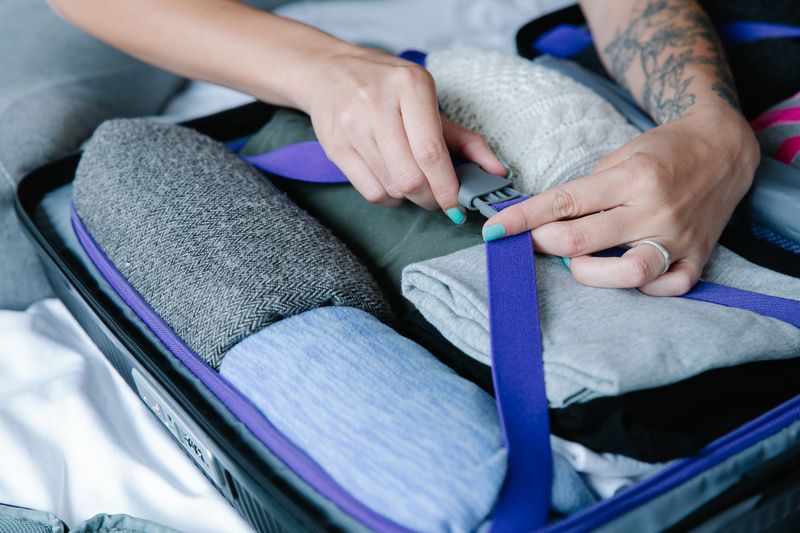
That asymmetry matters most on the way home, when packaging, laundry and purchases all expand the load at once. Leaving the compression straps slack on the outbound leg is therefore a deliberate choice rather than laziness. It also means the bag can still pass a gate sizer on the return, when it is fullest and enforcement is no gentler.
The mechanical argument
A bulging bag pulls its zip teeth apart sideways, which is the loading condition that zips resist worst of all. Seams take the same outward pressure, concentrated at the corners where the fabric changes direction abruptly.
Overfilled soft bags also lose their shape, which stops them sitting flat in an overhead bin or a luggage rack. Hard cases packed beyond their depth stop closing squarely, and the latches then carry loads they were never designed for. Every failure described here happens on the return leg far more often than the outbound, for exactly this reason.
Decide what the space is for
Naming the purpose in advance stops the space quietly filling with things you never intended to bring. On a work trip it might be documents and a laptop bag that has to fit inside the main bag for the flight.
On a long trip, on a long trip it is usually laundry, since dirty clothing occupies more volume than the same clothes did folded and clean. On a trip with a specific purchase in mind, the space is that purchase, measured before you leave rather than hoped for afterwards.
A defined purpose is testable, so you can check on the last morning whether the plan survived contact with the trip.
How much is right
About a fifth is a reasonable default, roughly the volume of a folded jacket plus a day of worn clothing. Short trips with no shopping and no change of climate can run tighter, because nothing new is going to appear. Trips that end with a gift, a conference bag or a market visit need more, and the honest number is often a quarter.
If you routinely arrive home with the bag straining at its zip, the right number for your trips is larger than you think. The measurement that matters is the return leg, because that is when the constraint actually binds.
Allowances vary by fare class more than by airline.
The alternative is a second bag
A packable tote or dry bag weighs very little and expands capacity on the one day you genuinely need it. It also gives you somewhere to put wet or dirty items without contaminating everything else in the main bag. On flights it can serve as the personal item, provided it fits under the seat and the carrier counts it that way.
From the queue, this is a hedge rather than a plan, and it works only if you stop the main bag expanding to meet it. Used deliberately, it turns a fixed bag into a bag with a defined and reversible amount of stretch.
The takeaway
Pack to four-fifths, decide what the last fifth is for, and check on the last morning whether you were right.
Pack for the trip you are actually taking, not the one in the photographs.
Questions readers ask
Does leaving space just mean I pack more?
Only if the space is undefined. Name what it is for before you leave and the discipline usually holds.
What about expandable cases?
The expansion zip is useful, but a case in its expanded state often fails a cabin sizer and puts the zip under most stress.
Also by Nadia Halloran
- Jet lag has a direction, and that changes what worksTravel Routine
- Rail passes are usually the wrong answer, and sometimes the right oneTrains & Ground
- Hostels, guesthouses and the middle nobody booksWhere You Sleep
- Doing laundry on the road is a planning decisionTravel Routine