
Trains & Ground
Where you stand on the platform decides the next twenty minutes
Trains do not stop randomly, and neither should you. Position on the platform determines the seat you get and the exit you reach.
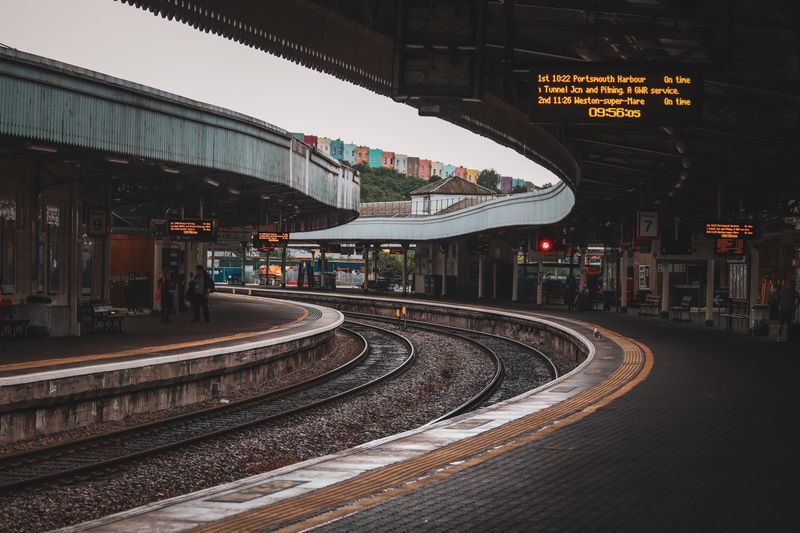
Most explanations of boarding a train stop at the point where it starts to matter. This one carries on.
The short version
- Coach positions are marked on platforms and repeat from day to day.
- Standing in front of a door slows boarding for everyone including you.
- The coach you choose decides how far you walk at the destination.
Trains stop in the same place
Platforms are marked with coach positions, letters or numbers so that a given train comes to rest at a repeatable point. Drivers stop against a marker, and the formation of a scheduled service is usually identical from one day to the next. That means the coach you want will arrive within a few metres of the same spot on almost every occasion.
Indicator boards on many networks display the formation before arrival, including which end carries first class or the quiet coach. Learning to read that display converts boarding from a scramble into a short and unhurried walk.
Where the empty seats are
The middle of a platform is closest to the entrance at most stations, so the coaches stopping there fill up first. Walking to either end before the train arrives usually finds a quieter coach with more luggage space still available.
On services that split or join en route, one portion is often far busier than the other because of where it goes. Coaches next to a catering vehicle or a toilet see more through traffic, which matters on a long journey. None of this is secret; it is information most passengers simply do not look for until the doors are already open.
The boarding bottleneck
Doors are the narrowest point in the whole system, and anyone standing directly in front of one blocks the people getting off. Standing to the side and letting the train empty first is faster in aggregate and usually faster for you personally. Dwell time at a station is scheduled, and a train that overruns it can lose its path and arrive late at the far end.
On busy commuter networks this is the main source of the small delays that accumulate across an entire line. Boarding through the nearest door and then walking inside the train beats walking along the platform after it arrives.
Luggage changes the calculation
Racks at the ends of coaches are limited and fill from the first people to board, so a late boarder carries a bag down the aisle. Overhead racks on many trains accept a soft bag but not a large hard case, which is a design decision rather than an oversight. Boarding at the correct door for your reserved coach avoids dragging a case through several vestibules and past standing passengers.
On very busy services the space between seat backs becomes the fallback, and it is worse for everybody involved.
A bag you can lift above your head is worth more on a train than a bag with better wheels.
Position for the exit
At the destination the exit is rarely at the middle of the platform, and large stations are genuinely long. Choosing a coach at the correct end saves a walk with luggage and puts you ahead of the crowd at the barrier. On networks with onward connections, the right end can decide whether a tight change is made or missed.
At the airport, station diagrams showing exit positions are published by many operators and displayed inside some trains. This matters most at large termini, where the walk from the far end of a platform takes several minutes.
Allowances vary by fare class more than by airline.
Habits that transfer between countries
The principles hold everywhere: read the formation, walk to the right position, stand aside, and board without blocking anyone. What changes is the signage, the numbering convention, and whether doors open automatically or need a button pressed. Doors requiring a button or a handle catch out visitors constantly, and a train can leave with somebody still standing outside it.
Local etiquette about queueing on a platform varies, and copying what everybody else is doing is the safe default. Five minutes of observation at an unfamiliar station is worth more than any amount of general advice.
The takeaway
Read the formation, walk to the right marker, and board where you want to be standing when you get off.
Pack for the trip you are actually taking, not the one in the photographs.
Questions readers ask
How do I know which coach will stop where?
Platform markings plus the formation display, where the operator provides one. On regular services the arrangement repeats daily.
Is it worth boarding early?
For luggage space, yes. For a seat on a fully reserved service, no, because that seat is already yours.
Also by Nadia Halloran
- Jet lag has a direction, and that changes what worksTravel Routine
- Rail passes are usually the wrong answer, and sometimes the right oneTrains & Ground
- Hostels, guesthouses and the middle nobody booksWhere You Sleep
- Doing laundry on the road is a planning decisionTravel Routine


